
The Contradiction That Actually Isn’t: Anglican Ink, GAFCON, and the Method Nobody Is Using
A Concerned Anglican I www.virtueonline.org I May 14, 2026
A Virtueonline Exclusive
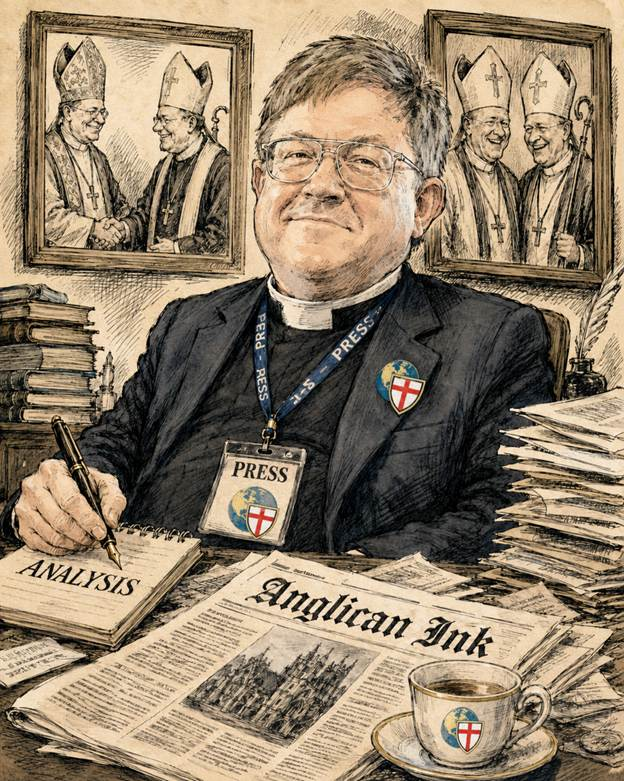
George Conger’s response to Jay Thomas in Anglican Ink is being presented as theological analysis. https://anglican.ink/2026/05/12/analysis-the-abuja-contradiction-that-isnt/ It is not. It is institutional apologetics, a defense of GAFCON and the Anglican Church in North America dressed in the vocabulary of Anglican ecclesiology. Before engaging the argument on its merits, it is worth pausing to note what Anglican Ink actually is, because the publication’s identity is directly relevant to how its “analysis” pieces should be received.
Conger is simultaneously the editor-in-chief of Anglican Ink and a regular on-air commentator on Anglican Unscripted, where he has made no secret of his sympathies in recent Anglican institutional disputes. He is an Episcopal priest in an ACNA-aligned diocese. Anglican Ink’s coverage of the past year’s Anglican institutional crises, which have been substantial, follows a consistent pattern: ACNA institutional communications receive prompt, prominent, primary-document treatment; parties on the other side of ACNA disputes receive press-release coverage or none at all. The November 2025 publication of an unverified “open letter from victims” in an active canonical dispute, without apparent editorial evaluation and without response from the accused, illustrates the standard. This is not journalism. It is advocacy with a masthead. Readers should receive Conger’s “analysis” of GAFCON’s critics accordingly: as the in-house commentary of a committed partisan, not the assessment of a disinterested observer.
That said, institutional bias does not automatically produce wrong conclusions, and the strongest version of the critique requires engaging the argument rather than simply dismissing the arguer. So let us engage it.
What Thomas Gets Right
Jay Thomas’s First Things essay “Anglicans and the Abuja Contradiction” https://firstthings.com/anglicans-and-the-abuja-contradiction/ has real weaknesses. His authority structure leans toward a magisterial co-equality of Scripture and tradition that the English Reformers explicitly rejected, and Conger is not wrong to note that the logic of that position, pursued consistently, leads somewhere Thomas appears unwilling to go. The Reformers made a decisive choice: doctrinal faithfulness over institutional continuity. Thomas seems to want institutional continuity without the apparatus that historically made it function.
But Thomas’s diagnosis of GAFCON’s incoherence is substantially correct, even if his prescription fails. He is right that GAFCON’s Jerusalem Declaration involves a confessional structure (a list of things that must be believed and held) while simultaneously treating women’s ordination as a tolerable “second-order” disagreement. He is right that this requires explanation. He is right that GAFCON offers none. His instinct, that something more principled is needed than institutional assertion, points toward a real solution, even if he cannot quite locate it. He is moving in the right direction. He simply does not arrive.
The Elizabethan Settlement Is Not the Answer. It Is the Disease.
Conger’s central counter-argument is that GAFCON’s position, communion on sexuality, tolerance on women’s ordination, mirrors the logic of the Elizabethan Settlement, which maintained doctrinal boundaries while permitting ceremonial and interpretive diversity. This is the weakest move in his piece, and it is worth dwelling on why.
The Elizabethan Settlement was not, at its foundations, a principled theological achievement. It was a political accommodation that required theological clothing. Elizabeth needed a national church broad enough to hold a fractured nation together, and the Settlement accomplished that by deliberately leaving unresolved the most contested questions: the precise nature of eucharistic presence, the theology of episcopacy, the extent of predestinarian commitment. Hooker’s celebrated Laws of Ecclesiastical Polity is a work of genuine theological depth, but its enduring argument for comprehensiveness as a virtue was shaped, inevitably, by the political necessities it was written to serve.
The Caroline Divines inherited that ambiguity and worked with extraordinary brilliance within it, recovering the patristic sources and deepening Anglican theological reflection in ways that remain indispensable. Yet the ambiguity itself carried consequences they could not fully anticipate. Comprehensiveness as a governing principle does not stay bounded by the intentions of those who first deployed it. It licenses progressive expansion of the tolerable. Chillingworth, Tillotson, the broad churchmen of the nineteenth century, the revisionists of the twentieth: these are not aberrations from the Settlement’s logic so much as its eventual destination, given enough time and cultural pressure.
When Conger invokes the Elizabethan Settlement as a model for GAFCON’s comprehensiveness on women’s ordination, he is not pointing to a stable solution. He is pointing to the mechanism that produced the very crisis GAFCON exists to address. This is not a minor irony. It is the fatal flaw in his entire argument.
Women’s Ordination Is Not a Second-Order Issue
GAFCON’s designation of women’s ordination as a “second-order” question is presented as theological wisdom. It is institutional arithmetic. The Global Anglican Communion cannot hold together without the provinces that ordain women, therefore women’s ordination must be second-order. The theological rationale is reverse-engineered from the political conclusion. Conger calls this “necessary untidiness.” A more precise description is a structural contradiction at the foundation of the entire enterprise.
The question is not merely whether women’s ordination is defensible or indefensible as a practice. The question is what hermeneutical infrastructure is required to sustain it theologically. The answer is substantial. To defend women’s ordination, one must argue: that the universal patristic prohibition is simply the imposition of Greco-Roman patriarchy rather than apostolic teaching; that the Church’s authority to alter the form of ordained ministry is essentially unlimited provided it serves contemporary justice categories; and that the hermeneutical principle governing scriptural interpretation is the trajectory of liberation rather than the consensus of the undivided Church.
Each of those moves, once made, is not containable. If patristic consensus on orders is dismissible as culturally conditioned, on what principled basis is patristic consensus on sexual ethics not equally dismissible? The revisionist answer, stated with full logical consistency, is: it is not. And they are right, given their premises. Every province that moved from women’s ordination to blessing same-sex unions followed exactly this trajectory with internal logical coherence. Canterbury did not abandon orthodoxy on sexuality despite accepting women’s ordination. Canterbury abandoned orthodoxy on sexuality because it had already installed the hermeneutical framework that women’s ordination requires.
GAFCON is attempting to use that framework while containing its conclusions. This is not untidiness. It is building on sand. Thomas senses this. Conger, invested as he is in GAFCON’s institutional project, cannot afford to see it.
The Instrument Neither Side Is Using
Conger correctly observes that classical Anglicanism has always recognized hierarchies of doctrine, that not every theological question carries equal weight, and that the tradition of theological triage is Anglican, not Protestant-confessionalist. He is right. But he never answers the obvious follow-up question: by what principled, historically grounded method do you actually perform the triage? Assertion is not a method. Institutional convenience is not a method. “Classical Anglican comprehensiveness” is not a method; it is a description of an outcome, and as we have seen, it is an outcome that progressively expands until nothing is excluded.
Thomas gestures toward something like a method. His appeal to “the church’s historic and magisterial tradition” alongside Scripture suggests he understands that principled triage requires a principled standard. He simply cannot specify what that standard is, because he has not articulated a methodology for evaluating tradition that is neither Roman (tradition as co-equal magisterial source requiring a living adjudicating authority) nor Protestant (tradition as secondary and contestable by individual scriptural interpretation).
The Anglican tradition already possesses the instrument that resolves this impasse. It is not new. It was articulated in 434 AD by Vincent of Lérins and deployed, with varying degrees of rigor, by the Caroline Divines who gave Anglican theology its most durable intellectual architecture. The Vincentian Canon (quod ubique, quod semper, quod ab omnibus: what has been believed everywhere, always, and by all) provides a principled, historically grounded, non-Roman basis for distinguishing what is irreversible apostolic deposit from what is later theological development or outright innovation.
Applied with rigor, the Canon is neither Anglican Ink’s friend nor GAFCON’s. Sexual ethics grounded in creation order, confirmed by universal patristic consensus across East and West, expressed in every ancient liturgical tradition, never seriously contested in the undivided Church: this passes the test. It is first order, non-negotiable, and the Vincentian methodology confirms it as such. Women’s ordination, absent from the entire undivided Church, patristically prohibited without dissent, not present in any ancient liturgical tradition, and dependent on hermeneutical moves the Fathers neither made nor entertained, fails the test decisively. The Elizabethan Settlement failed to apply this instrument, and that failure created the latitudinarian drift that Canterbury now embodies. GAFCON is repeating that failure at a different point on the same trajectory.
This is not a Roman position. Lancelot Andrewes, arguing against Bellarmine, was not on his way to Rome when he appealed to the patristic consensus of the undivided Church. He was deploying exactly the methodology Thomas is trying to reach and Conger refuses to engage. The Vincentian Canon is more authentically Anglican than either the Jerusalem Declaration’s confessionalism or the Elizabethan Settlement’s comprehensiveness. It predates both. It grounds Anglican reformed catholicism in something older and more durable than either: the irreversible deposit received by the undivided Church and confirmable by the threefold test of antiquity, universality, and consensus.
A Future Worth Investing In
Thomas asks whether GAFCON represents a coherent Anglican future. Conger answers yes, with the Settlement’s ambiguity as his warranty. Both answers are inadequate.
A coalition that institutionalizes the hermeneutical framework that women’s ordination requires and that has demonstrably produced the revisionism GAFCON opposes is not a future worth the investment of orthodox Anglican energy. Not because GAFCON’s people are insincere, but because the foundation is methodologically compromised. The Elizabethan Settlement bought approximately four centuries before the rot became undeniable. GAFCON’s version of the same bargain will buy less time, in a faster-moving culture, with a weaker institutional framework.
The actual Anglican future, if there is one worth having, belongs to those willing to apply the wisdom of Saint Vincent with integrity rather than convenience. That means first-order questions are determined by patristic consensus across the undivided Church, not by what a particular coalition can tolerate. It means the Elizabethan Settlement is received honestly as a political achievement with serious theological costs, not as a model of principled comprehensiveness. It means Thomas’s instinct toward “the church’s historic tradition” is taken seriously and given the methodological rigor it requires, rather than being dismissed as crypto-Romanism by an editor who cannot distinguish the Caroline Divines’ patristic method from Bellarmine’s magisterialism.
George Conger is right that GAFCON’s triage is classically Anglican in form. He is wrong that the Elizabethan Settlement validates it, wrong that institutional comprehensiveness is an answer rather than a symptom, and wrong that Thomas’s appeal to tradition automatically leads to Rome. What leads to Rome is the absence of a principled non-Roman method for evaluating tradition. The Vincentian Canon is that method. The Caroline Divines knew it. Vincent articulated it in the fifth century. It does not require Canterbury’s blessing or GAFCON’s endorsement to be true.
Jay Thomas’s piece: Anglicans and the Abuja Contradiction can be seen here: https://firstthings.com/anglicans-and-the-abuja-contradiction/


The Elizabethan Settlement is Anglicanism. Abandon it and you must find a new home. I wish you well, and be blessed.
George Conger still remains a priest in the Episcopal Diocese of Central Florida. While they claim to be a "conservative" diocese, they aren`t. They are in full communion with an apostate, dying denomination, who has totally rejected the clear word of God on human sexuality and marriage, and the sanctity of human life, from conception to natural death. The "conservative" bishops in these dioceses will be replaced by apostates and soon they also will be in their road to oblivion that follows with the rejection of the Christian faith.
It's somewhat disappointing that the archives of articles on the previous Virtue Online site are no longer available, for two things could be seen: firstly, that articles and contributors were universally pro-ACNA and pro- GAFCON; and secondly that some commenters were saying that they both contained the seeds of their own fall, which are exactly those indicated here, well before this "non-controversy." I am sure that those who joined in the discussion those few years ago are now filled with horror to see the flower that is produced from the seed.