
UK: All new diocesan bishops must accept the ordination of women, campaign group demands
- Apr 29
- 3 min read
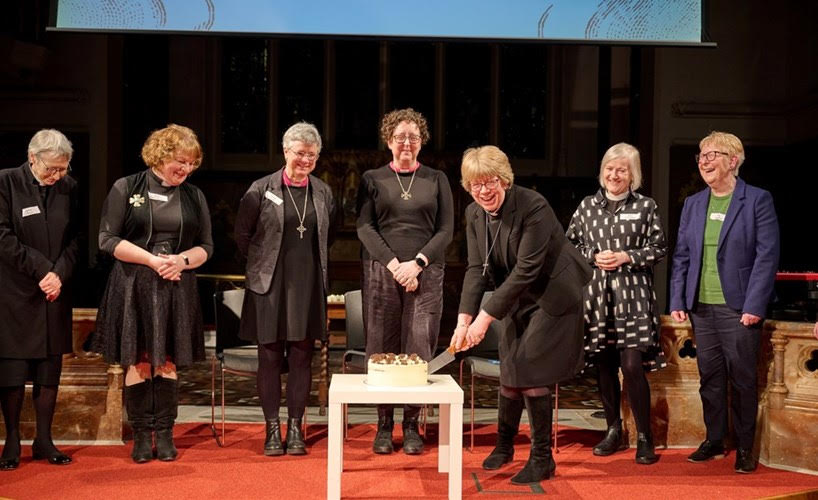
Petition is published by Watch before appointment of next bishop of London
by Madeleine Davies
CHURCH TIMES
29 April 2026
The Archbishop of Canterbury (centre), then Bishop of London, cuts a cake at an event in January 2024 to celebrate 30 years of women priests
A PETITION calling for a bar on the appointment of diocesan bishops who do not accept the ordination of women has been launched by Women and the Church (WATCH).
It was published on the website change.org on 24 April, in response to the publication of the Statement of Needs by the vacancy-in-see committee in the diocese of London. While some committees have specified that they seek a bishop who will ordain women, the London statement seeks “someone who evidences a strong track record of advancing ordained women’s ministry and enabling its flourishing, irrespective of whether they personally will or will not ordain women to the priesthood”.
It stipulates that the candidate should be “someone with a strong track record in mutual flourishing, working well across traditions, with gospel generosity, which will include evidence that they will be able to operate the London Plan to give full effect to the House of Bishops’ Declaration on the Ministry of Priests and Bishops and its Five Guiding Principles, so that all vocations can be advanced and celebrated.”
The WATCH petition states: “We do not want a bishop who does not ordain women as priests or recognise the spiritual authority of female bishops — including the archbishop of Canterbury! Such a bishop would be a sign of division rather than unity. We would not accept his authority.
“We also call for a change in the Church’s rules, so as to preclude the possibility of such an appointment. We seek the amendment of the Declaration and the Five Guiding Principles to ensure that no opponent of women’s ordination is ever again appointed to a diocese. It is too glaringly contrary to episcopal order and Church unity, that a diocesan bishop can oversee clergy whose authority he denies. We demand a vote in Synod on the issue.”
On Wednesday, it had been signed by more than 900 people. The primary signatory is Dr Theo Hobson, a theologian and journalist who is training for the priesthood.
A joint statement issued on Tuesday by Forward in Faith, the Church Society, and ReNew said: “We are glad to see the ongoing commitment of the Diocese of London to the mutual flourishing of men and women in ministry, and especially their commitment to the House of Bishops’ Declaration and the Five Guiding Principles, which allows for those who cannot in good conscience accept the priestly ministry of women to continue to flourish in ministry at all levels of the Church of England.”
The Statement of Needs “takes a substantially similar position on this issue to their last Statement of Needs, which led to the appointment of Sarah Mullally”, it said.
The national director of the Church of England Evangelical Council, the Revd John Dunnett, said: “Whoever is appointed as the next Bishop of London will, we trust, be committed to the five Guiding Principles. Of even greater and primary importance, they must hold to, teach and advocate the doctrine and teaching of the Church of England as we have received it.”
The House of Bishops’ Declaration that accompanied the 2014 legislation enabling women to be consecrated to the episcopate says that, in a statement of needs, “dioceses are entitled to express a view . . . as to whether the diocesan bishop should be someone who will or will not ordain women.
“In dioceses where the diocesan bishop does not ordain women he should ensure that a bishop who is fully committed to the ordained ministry of women is given a role across the whole diocese for providing support for female clergy and their ministry.”
It also states that “it will be important that senior leadership roles within dioceses continue to be filled by people from across the range of traditions.”
The diocese of London has the largest number of parishes that have passed a Resolution of any diocese: 56 traditionalist Catholic parishes and 24 conservative Evangelical parishes, totalling roughly one in five. Under the London Plan, in place since the 1990s, the Bishop of Fulham ministers to traditional Catholic parishes and the Bishop of Ebbsfleet to conservative Evangelical parishes.
END


Jeśli szukasz informacji o tym, jak skutecznie reklamować firmę, warto zajrzeć do artykułu opublikowanego na Billboard-Portal. Tekst https://billboard-portal.pl/2026/08/08/billboardy-reklamowe-czy-reklama-internetowa-co-wybrac-dla-swojej-firmy/ przedstawia różnice między billboardami reklamowymi a reklamą internetową. Można w nim znaleźć informacje dotyczące zasięgu, kosztów oraz sposobów docierania do potencjalnych klientów. Autor zwraca również uwagę na znaczenie odpowiedniego dopasowania reklamy do rodzaju działalności. Przeczytanie artykułu może ułatwić wybór kierunku dalszych działań promocyjnych.
Thank you for this clear and informative article. The subject is explained in a straightforward way, making it easy to understand. Content like this is helpful when learning about how digital media platforms are evolving. Your Eyes and Ears Can Deceive You. Dialed GG Game
Its very sad to see the Church of England in the path for self-destruction.